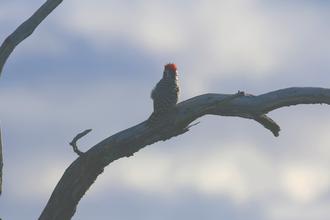
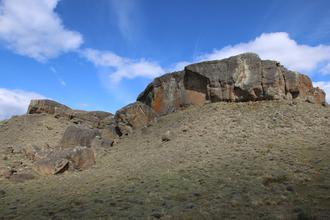
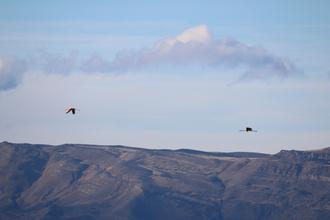
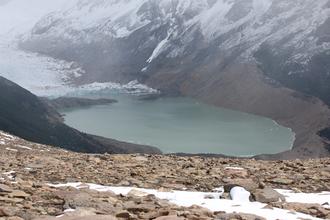
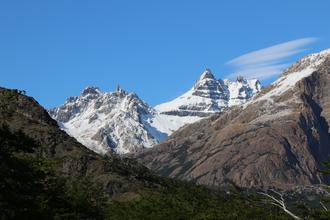
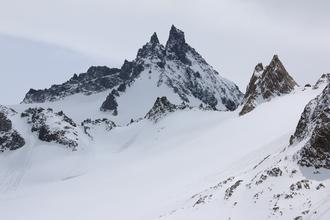
Here is our account, with photos, of a wonderful holiday in Patagonia in November 2016.
To enlarge any picture, just click on it.
Santiago
We landed in the morning at Santiago. After a short delay to report our lost
luggage we went on a tour of the city starting with the impressive Santa
Lucía park from where we had good views over the city. We
walked around the centre where we were shown the
buildings from the time of Allende, which were very cubic in design, the cathedral, which is not a cathedral, the museum and the fish market.
At
the fishmarket we had a good but rather chaotic late lunch. Our guide, Roberto,
told us quite a lot of history including that of the Mapuche people
who had resisted the Spaniards. We also heard about the earthquakes and how
often they occurred. In the evening we enjoyed a meal with good views of the mountains behind the city.
Despite a hopeful text our luggage did not appear.
Statue, Cerro Santa LucíaAraucaria, Cerro Santa LucíaView from Cerro Santa Lucía
El Morado
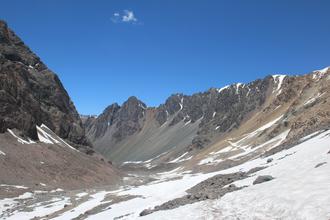
We drove up the Maipo valley until the road became a bumpy track used by lorries
building a hydro electric plant. Our walk was through a spectacular valley and up to the El Morado
lake which is dominated by a hanging glacier. We saw some interesting birds
including the Patagonian sierra finch with its yellow and green plumage. As we walked up to about 3200 metres and on snow for the most
part the walk was quite tough but very rewarding. Camilla was grateful to our second guide, Macharina,
for the loan of her poles.
We returned to the hotel, stopping twice, once to watch a condor and once for a barbecue dinner.
No sign of our luggage.
Patagonian Sierra FinchEstero El MoradoEstero El Morado
Cerro El MoradoCerro El MoradoEl Morado
Going downView down Estero El MoradoMaipo valley mountains
To Puerto Natales
We went to the airport for our flight to Punta Arenas, hoping to pick up our lost luggage.
The Iberia office, which took some finding, were unable to help us
in the time before our flight. We were met at Punta Arenas by Francesca
who took us shopping for necessary equipment as there was no sign of our
luggage although some promises! We then drove to Puerto Natales where we
met our guide Claudio and were told about the boat trips planned for the next day.
He did admit to a plan B if the wind was too strong. The group were very patient
about the delay we caused in having to go shopping. Camilla now had a waterproof coat and David had walking trousers. We could cope!
Puerto Natales and the journey to the Ecocamp
One glance at the sea told us that it would be plan B! Although we were all
ready for an early start we no longer had to make one and so were able to walk
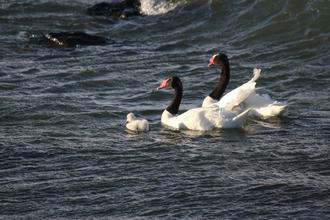
along the shore and enjoy the bird life and some interesting sculptures. We saw black-necked swans with cygnets,
various types of duck (Chiloe wigeon, speckled teal, crested duck). We also saw tern,
possibly Arctic, a couple of Magellanic oyster catchers (black and white with red beaks like their northern hemisphere counterparts but with pink legs and bright yellow eyes),
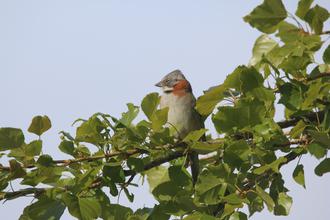
Southern lapwings, and rock cormorants and were serenaded by a chincol or rufous-collared sparrow.
Black necked swansMylodon statueSculpture, Puerto Natales
Oyster CatcherRufous-collared sparrowRainbow, Puerto Natales
We then got on the bus and went to the Mylodon cave which is huge, has good stalactites and was home to the now extinct mylodon a scupture of which we had seen in Puerto Natales. We learnt about the three main local trees,
two of which are a type of beech and have an attractive parasitic growth which consists of
yellow and orange threads.
We then went to an Argentinian border village where we bought a useful wildlife guide.
On the drive from there to the Ecocamp we saw a rhea, some black faced ibis,
some beautiful Chilean flamenco, lots of guanaco, lots of upland geese,
Andean condors, and black-chested buzzard-eagles.
After an excellent lunch and finding our domes we went out again to
see the impressive Cascada de Paine and a large herd of guanaco.
On the way we stopped to see some Austral parakeets.
Walking to see the guanaco we also saw austral negrito, also known as schoolboys,
which are small dark brown birds with a rufous back, the strangely named black-headed ground-tyrants,
Chilean swallows, Southern crested Caracara and a South American grey fox.
View from outside Mylodon CaveChilean FlamingosFirst view of Torres Del Paine
Austral ParakeetCascada de PaineGuanaco
Torres del Paine
Before breakfast we saw a striped
woodpecker and were entertained by a pair of caracara flying around and doing what caracara do in the spring. We then set off at 8:30 for a 21km walk up the Ascencio valley to the
'look-out' of the Torres. Our second guide at the Ecocamp, Marie, joined us. Like Claudio she was a great addition to the group. The sky had a good deal of blue and there was not
too much wind though we could see cloud around the Torres themselves. We soon
saw a flicker, another type of woodpecker, as well as southern lapwing. There were many wild flowers and we particularly liked the firebush with its bright red
honeysuckle-like flowers. We had a superb walk up the valley with the river beneath us. We stopped for lunch
at the refuge where lots of rufous-collared sparrows were pecking around and then proceeded
through woodland to the base of the final climb to the view point. The climb was
rocky but we managed well despite our inadequate footwear (still no luggage).
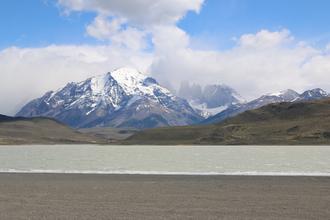
At the top we had a superb view of the creamy turquoise lake and towers although
the towers did have some mist clinging. On our way down we met a red fox and had
two good sightings of torrent ducks, the second sighting included male, female
and duckling. On the final stretch back to the campsite we had to stop for a large
herd of horses to cross the track and we saw black-chinned siskin in the trees.
An excellent day but still no luggage!
Cerro Nido de CondorWaterfall on the way upLago Torres
Lago TorresDark-faced
Ground-TyrantTorres Del Paine
Lago NordenskiöldMale Torrent DuckFemale Torrent Duck
Torrent Duck and
DucklingHorsesAustral Thrush
Cave paintings and views of Cuernos del Paine
The day started with a
walk via Laguna Goic and a cave with remnants of hand paintings. The views of the mountains, with their differently coloured bands of granite and sedimentary rock, were stunning.
On the bird front, there were
more flamingos, two white swans, some red-gartered coot, though we never saw their garters, and a long-tailed meadowlark. Why the latter is named for its tail rather its spectacular bright red breast is a mystery. We also enjoyed
the flowers including patagonian pea, guanaco bush, sand ladies slipper, common yellow
violet, wild geranium and escallonia.
View on the wayCave PaintingLayers of granite and sedimentary rock
Wild-blue PeaChilean Flamingos and Coscoroba SwansMountain View
Pumas may be hereGuanaco BushAustral Negrito
We were met by the bus at the end of the walk and taken to the Lake Pehoé
viewpoint from where we had a view, across a turquoise lake, of the horn of
Paine.
Lago PehoéLago PehoéCuernos Del Paine
The second walk of the day was past a superb waterfall to a viewpoint across
Lago Nordenskjöld. This walk had great views but was occasionally very
windy.
Still no luggage but a promise that one bag may reach us tomorrow. We have been
told that before!
Rio Paine waterfallRio PaineLago Nordenskjöld
French valley
The weather was not so good today. It had been very windy overnight but was
calmer by breakfast. We drove to a catamaran pier and took the boat across Lake
Pehoé to the beginning of the track up the valley. There were two foxes and
a Chimango Caracara near the beginning of the walk. The walk took us to a
viewpoint over Lagu Skottsburg and then past a small lagoon to follow the river
up the French Valley. We went through large areas of dead trees that resulted
from a huge fire in 2011. There were various wild flowers including the very
pretty dog orchid. After a bit over 7 kms we reached the 'Italian camp' via a
bridge not too unlike Carrickarede rope bridge. This was where Italian climbers
based themselves before climbing some of the peaks. After lunch we climbed a bit
further up the valley to two viewpoints. Although it was not completely clear
there were good views of the glaciers ahead and the turquoise lakes behind. We
returned the way we came. The weather had improved and Lagu Skottsburg was now bright blue but with strong gusts of wind blowing across its surface. We had a very good view of a fire-eyed diucon where we could clearly see its red
eye. It flew before the camera was quite ready!
On return to the ecocamp we found one of our bags and the news that the other
was being returned to the UK! Not good.
Lago SkottsbergWaterfall PlantView across Rio del Francés
Green lake in French
ValleyLayers of granite and sedimentary rockPrickly Heath
Chimango CaracaraNative AnenomeFire-bush
Lago SkottsbergWind on Lago SkottsbergOur dome
El Calafate
There was an early start, so as not to have to queue too long at the border.
There was also a hiccup as three pieces of luggage (including our - just
returned - one piece) had been put on the wrong bus. Fortunately we were able to
reclaim them at the border.
On the way to the border we saw some young rhea and some distant flamingos.
We had to go through two crossing formalities, one to leave Chile and one to
enter Argentina. After this we had a long drive across Steppe country until we
reached a look-out with a view of Lake Argentina and El Calafate.
We arrived in El Calafate in time for lunch and the afternoon was spent buying David various necessities including walking boots (hush puppies would you believe?) and walking to the
nature reserve where we saw flamingos (some in flight),
yellow =-billed ducks, a long-tailed meadow lark and a spectacled tyrant (sic).
FlamingosLong-tailed MeadowlarkChiloe Wigeon
Spectacled TyrantFlying FlamingosFlamingos
Perito Moreno
In the morning we drove up to the Perito Moreno Glacier where we did a 'board
walk' to view the glacier. The edges of the glacier are over a mile wide and
there were frequent rumbles as ice fell into the lake. After the walk we took a
boat trip that took us to within 300 metres of the glacier wall.
We were then taken to El Chalten through quite a lot of steppe and with glimpses of
turquoise lakes and rivers.
Perito Moreno GlacierPerito Moreno GlacierHole in Perito Moreno Glacier
Perito Moreno GlacierSierra-Finch at Perito MorenoPerito Moreno Glacier
Pliegue Tumbado
We left the hotel at 8:30 and made our way slowly and steadily upwards. We
passed across steppe, then forest and finally rocky moraine. There was some
snow on the trees and some lying. We reached a viewpoint overlooking a glacial
lake. It was too windy to climb the final hill so we had lunch and then returned
the way we had come, pausing for a successful fossil hunt on the way. The views all around
were great.
SoloView on the way upView looking back
View on the way upClimbing upThe hill we were meant to go up
View from the topFossilsLooking back to El Chalten
Walk via Fitzroy base camp
We woke to clear blue skies and little wind. A day for sunhats, sun cream, and
sunglasses. After a half-hour drive along a bumpy road, we set off on a lovely track through woodland but with great views of the mountains.
There was a steep climb to the main
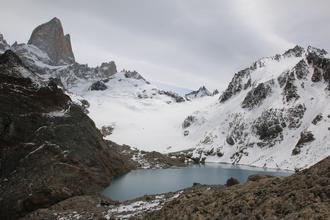
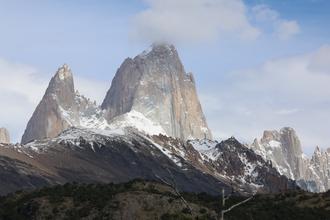
viewpoint for Mount Fitzroy and the turquoise Lago de los Tres where we took lunch. A few of us did an extra bit in order to view a second
lake, Lago Sucia, which was a deeper turquoise. It was a wonderful walk. Let the photos
show it!
FitzroyMountain viewView to the East
FitzroySnowy mountainFitzroy
Fitzroy and PoincenotLago de los TresLaguna Sucia
Both lakesLago de los TresMountain above Lago de los Tres
Ashy-headed GooseLaguna CapriRio de Las Vueltas
Laguna Torre
The walk today followed the Fitzroy river up to the glacial Laguna Torres, which we had seen from above two days earlier. It passed through various
types of forest and crossed moraines left by glaciers from various ice ages.
The lagoon itself had a fair number of small icebergs that had broken from the
glacier.
Fitzroy and PoincenotRio FitzroyMorraine ahead
Information boardCerre Torre, Torre EggerSolo
Laguna TorreClose up of TorresIcebergs on Laguna Torre
MorrainesAbove Laguna TorreFired-eyed Diucon
Transfer to Tierra del Fuego
We drove back to El Calafate airport, said our goodbyes to most of the group who
were heading home and flew down to Ushuaia with Mel and John who were also doing the
extension to Tierra del Fuego. Awaiting us at Ushuaia airport was our second bag which appeared to have visited most of the airports in Chile and Argentina and had not in fact gone back to the UK. On arrival at our hotel, there was a
king penguin standing on the shore. He was apparently lost following
migration and he moved on when the tide came in.
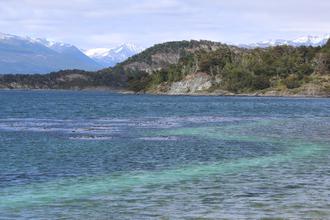
Southern LapwingKing PenguinLost? King Penguin
Penguins and Gable Island
The weather forecast was not very good but the actual weather was cloudy with
occasional drizzle rather than seriously wet. We drove to the Harberton Estate,
east of Ushuaia, and donned wellies, red waterproof trousers and life jackets.
After a brief description of how to use a paddle, eight of us boarded an
inflatable canoe along with our canoe guide. We canoed down a river and out into
the Beagle channel where we were lucky enough to see some Magellanic penguins
swimming nearby. We then landed and shed our waterproofs to then board a small
boat which took us to Penguin Island where we could observe the antics of the
birds from close by. After a sumptuous barbecue lunch on Gable Island we spent the afternoon walking across
the island and were introduced to some of the vegetation, some beaver dams and
descriptions of the Yamana people who originally inhabited thse parts.
Wind blown treeAmerican KestrelRio Lasifahaj
Magellanic PenguinAnother lost King PenguinMagellanic Penguins
Lunch place on Gabel IslandAzorella compactaAzorella compacta
Beaver DamBeaver LodgeCampanilla
Indian BreadWinter's GreenTurkey vulture
The national park
The weather today was glorious with blue skies and sunshine. We started with a
coastal walk. This was a real pleasure with clear sea, beaches and occasional
diversions into the forest. We saw various birds including a type of parakeet.
We were hoping to see a Magellanic woodpecker and had almost given uo hope when
Loretto, our guide, spotted one right at the end of the walk.
After another sumptuous lunch and suitably tanked up with red wine, we headed out
to canoe once more, this time in 4 person
canoes. There were not enough guides for each canoe to have one so the British,
that is Mel, John and ourselves, were assigned to one canoe and pushed out into the
lagoon. We canoed for a while but soon realised the others were going in a different
opposite direction. We caught them up and canoed down a river, narrowly avoiding
being grounded on a sand bank, and had to portage the canoes a short
distance onto a faster flowing river leading to Lapataia bay. We all took some
time out from paddling on this part of the trip, enjoying the sun, the wildlife and the views.
After this we returned to Ushuaia and a lightish dinner.
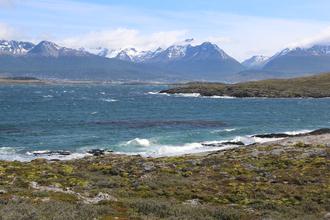
Chile across the Beagle ChannelDolphin GullPost Office at Fin Del Mundo
Green rocksPrimula MagellanicaSandy bank
Chimango CaracaraView from the coastal walkRock cormorants
We woke, again, to blue skies. In the morning we had a boat trip (Navigation) on
the Beagle channel out to the lighthouse Faro Les Eclaires. This was much enjoyed by all and had good views of sealions, great petrels
and cormorants as well as a short visit from some black-browed albatros.
We then had the afternoon to wander round Ushuaia before heading for the airport
and Buenos Aires. We visited the prison museum which, in fact is a collection of
museums, which we found quite interesting.
View from the boatUshuaia from the boatCormorants
Imperial Cormorant and Arctic TernImperial CormorantImperial Cormorant
SealionsSealionSealions
SealionsYoung sealionsSealions
Female Kelp GooseBeagle ChannelView from where we landed
Black browed AlbatrossLes Eclareurs LighthouseCormorant
Kelp goose (male)Flying CormorantCormorants near lighthouse
Kelp GeeseLes Eclareurs LighthouseGreat Petrel
Buenos Aires
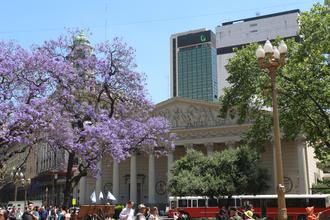
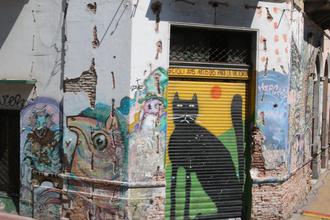
Our last day was spent exploring Buenos Aires. It was good to meet up with Gordon and Elisabeth who had been there for a few days. They were excellent guides! We partuclarly liked the Plaza de Mayo, the Floralis Genérica and the murals and colured houses in La Boca.
Plaza de MayoJacaranda in Plaza de MayoBlack cat mural
Four windows, La BocaFloralis GenéricaMural
Maps and details of walks
We tracked the walks using Viewranger, a mobile app, and Open Cycle maps. The pictures below are screenshots.